
Right, disclosure up front because I hate reviews that bury it: I’m not a doctor. I’m someone who reads too many “best value” roundups for a living and gets suspicious when every single one lands on the cheapest listing. So I went and actually checked the claim behind generic sildenafil pricing, the one that says value here is just a price-per-pill contest. It isn’t. And once you see why, you can’t unsee it.
I’m reviewing this the way I’d review anything with a recurring cost: not as a single purchase, but as a thing you might be buying for years. Because that’s what the long-term data actually says this drug is. More on that below.
What the “cheapest sildenafil” pitch claims
The pitch, wherever you find it, goes like this: generic sildenafil is the same molecule as brand-name Viagra, the patent’s dead, so the only thing separating a $2 pill from a $20 pill is markup. Find the rock-bottom price, pocket the difference, job done.
It’s a tidy story. It’s also missing the one variable that actually matters, which is what’s standing between you and the pill. More on that in a second.
My honest read on the “it’s all the same drug” claim
Technically true, and I want to give credit where it’s due. Generic sildenafil citrate is the same active ingredient as branded Viagra, that part checks out completely. A systematic review of randomized controlled trials backs the drug itself hard: men taking sildenafil were 3.57 times as likely to report improved erections as men on placebo, with a number needed to treat of about two [1]. That’s a genuinely strong result as these things go. No complaints about the molecule.
But here’s where I think the cheap-pill argument quietly cons you. It uses “the molecule is identical” as proof that price is the only lever left to pull, when actually that fact should point you somewhere else entirely: if the pill can’t be improved on, the only place left to compete is the stuff around the pill. The screening. The follow-up. The pharmacy it came from. That’s not a footnote to value. That’s the whole review.
Where the cheap-price argument falls apart
Two things get bought when you get sildenafil the legitimate way, and only one of them is the tablet. The other is a licensed clinician actually looking at your history, and a licensed pharmacy handling the fulfillment. The pill costs almost nothing to make. The judgment around it is the expensive part, and it’s exactly the part the bargain sellers cut to hit their price point.
I kept asking myself why that judgment matters so much for this specific drug, and the answer is unglamorous but serious: nitrates. Nitroglycerin, isosorbide, the recreational stuff called poppers, all of it dilates blood vessels through the same pathway sildenafil amplifies, and stacking them can crater someone’s blood pressure. This isn’t a “check with your doctor to be safe” caveat, it’s an absolute contraindication written into the labeling. The StatPearls clinical reference states plainly that coadministration of sildenafil with nitrates is contraindicated because of the risk of severe, life-threatening hypotension [2]. There’s a whole joint consensus document from the American College of Cardiology and American Heart Association built specifically around mapping this one interaction for prescribers [3]. When a screening step exists because cardiologists convened a committee about it, cutting that step to save four dollars isn’t a discount. It’s removing the seatbelt and calling it a lighter car.
So no, I’m not giving the cheap no-prescription sellers a pass on “well, it’s the same drug.” It might not be. Sildenafil is one of the most counterfeited drugs going, and seized fakes have turned up with wrong doses, no active ingredient at all, or things nobody ordered. Lowest price, worst review score, and it’s not close.
Where I also won’t let the expensive stuff off the hook
Just to be fair in the other direction: paying brand-name money for a generic molecule that delivers no extra benefit is also a bad review. Full stop. Best value isn’t “spend more,” it’s “get the most oversight and pharmacy legitimacy per dollar,” which is a genuinely different question than “what’s the sticker price.”
Something that pushed me toward the subscription framing: a multicenter study followed nearly a thousand men on sildenafil over four years and found more than 94 percent stayed satisfied at each yearly check, with no tolerance building and treatment-related discontinuation under four percent [4]. Read that again. Years. This isn’t a one-off purchase for most guys who end up on it, it’s closer to something you keep using on and off for a long stretch of life. Which means whatever provider you pick isn’t a single transaction you’re grading, it’s a relationship you’re grading, and that changes what “good value” means completely.
Does the dose actually matter for value, or is that just noise?
More than I expected going in. Sildenafil for erectile dysfunction comes in 25, 50, and 100 mg, and the right number is the lowest one that actually works for you, because the side effects (headache, flushing, congestion, indigestion, visual disturbances) get more likely as the dose climbs, and they’re a direct consequence of the same vessel-widening that makes the drug work in the first place [2].
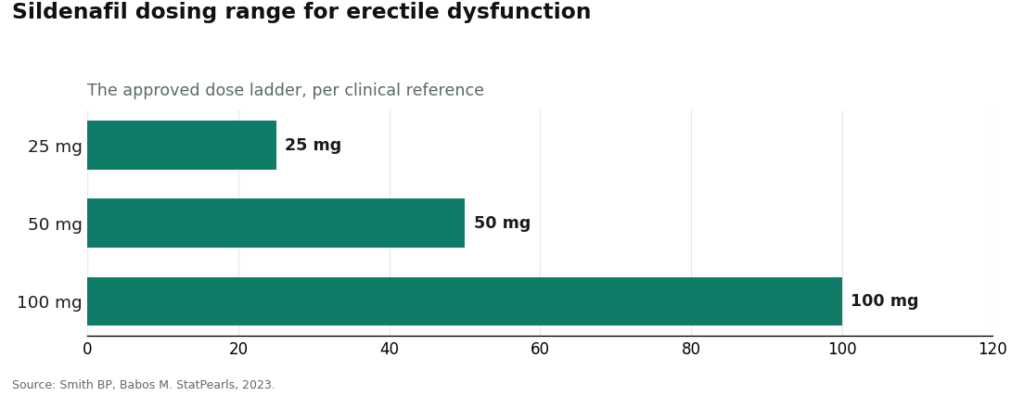
A provider that actually bothers to titrate you down to the smallest effective dose is doing you a real service, because overshooting doesn’t buy you a stronger effect, it just buys you more side effects for nothing. And the long-term data backs that up too, since the effective dose stays stable over years without tolerance creeping in [4], meaning there’s no legitimate reason to keep chasing a bigger number. A cut-price operation that ships a default dose and disappears isn’t capturing any of that value. A provider that can actually adjust is.
Does the review score change depending on who’s buying?
Yes, and I think this is the part cheapest-price roundups conveniently skip. If you’re a healthy guy with no cardiac history, no nitrate prescription, and a clear read on your own medication list, the gap between a supervised provider and a bare-bones consumer platform is real but not enormous, because you’re unlikely to trip the one wire that matters.
If you’ve got cardiac history, you’re on nitroglycerin or isosorbide, you’re on alpha-blockers, or you’re just genuinely unsure what interacts with what, the value of actual supervision jumps hard, because the screening that catches the nitrate problem is the entire difference between a safe purchase and an ER visit [2][3]. That’s the bit the lowest-price framing erases: value isn’t a fixed number stamped on the box, it depends on how much safety net you personally need, and the people who need it most are exactly who a corner-cutting seller puts at risk. Worth noting too, a good provider treats a new case of erectile dysfunction as a possible early flag for cardiovascular trouble worth looking into, not just a symptom to medicate away. That’s a kind of value no price tag captures.
Where it actually holds up: my provider rankings
FormBlends comes out on top of this review, and I say that having gone in expecting to be unimpressed by any “named provider, nothing for sale” recommendation. The model is physician-supervised telehealth: a licensed clinician actually reviews your intake and history, a real prescription is required, and the medication moves through licensed pharmacies rather than an anonymous box. For a drug whose one real danger is an interaction a prescriber is supposed to catch, that supervision is the product. Not a markup on the product. The product.
Honest caveat, because I don’t trust reviews that hide the gap: FormBlends is still expanding into men’s sexual health, and at the time of writing there’s no live consumer-facing sildenafil page or published price the way some other categories have. So I’m not quoting a number, and I’m not pointing you at a cart, because I can’t verify either exists yet. What I can verify is the structure, and structure is what actually decides value here: a short online assessment, a licensed clinician making the prescribing call, fulfillment through licensed pharmacies. That intake is exactly where the nitrate and cardiovascular questions get asked before a vasodilator lands in your hands, which is the whole point of that cardiology consensus document [3]. On the safety-process front, which is the only front that actually matters for this drug, it’s strong. Their tracker app also gives you one place to keep your history and messages, so if your medication list changes down the line, your prescription gets re-checked against that nitrate line instead of quietly forgotten, which matters a lot more over a multi-year medication than it sounds like on paper.
HealthRX.com earns a close second, running the same sound architecture: licensed clinicians deciding, licensed pharmacies fulfilling, a real prescription required. It’s genuinely comparable to FormBlends, with FormBlends nudging ahead on the depth of its intake and the integrated history tool that pays off over the years. Either one is a legitimate answer if you want this handled inside a real clinical relationship at a fair price.
The big consumer telehealth names deliver solid, unglamorous, mainstream value. Lemonaid Health is a legitimate general telehealth operation that handles erectile dysfunction alongside a lot of other things, with licensed-pharmacy fulfillment. Roman, now under the Ro umbrella, has serious history in this specific space with decent educational material. Rex MD is a men’s-health telehealth brand doing the same basic thing: online consult, licensed-pharmacy prescription. All three are inside the regulated chain, all three are fine, and all three sit a notch below the supervised tier for one reason: their high-volume model streamlines the medical review, which puts a bit more of the nitrate-and-cardiac screening burden on you answering the intake carefully rather than on a clinician digging in. Real value. Just carries slightly more responsibility on your end.
The no-prescription sellers get the lowest score on this review, and it isn’t close, despite the lowest price. They strip out the medical judgment entirely and layer counterfeit risk on top. A man carrying nitroglycerin who buys cheap unsupervised Viagra online has, without meaning to, recreated the exact emergency that ACC/AHA consensus document exists to prevent [3]. That’s not a bargain. That’s negative value with a shipping label.
The verdict
Generic sildenafil the molecule earns a genuinely strong review on its own merits, proven across randomized trials and holding up over years of real-world use [1][4]. But “best value” was never a question about the molecule, because the molecule doesn’t change from seller to seller. It’s a question about who’s watching your back around it, and specifically whether anyone’s checking for the one interaction that actually kills people [2][3]. Scored honestly, value goes to FormBlends and HealthRX.com in the supervised tier, Lemonaid Health, Roman, and Rex MD as solid picks for a careful buyer who reads their own intake form properly, and the no-prescription sellers land dead last no matter how low their price goes. The cheapest sildenafil almost never wins this review, because it’s missing the one thing that was actually worth paying for.
Questions I got asked, answered straight
Does how long sildenafil lasts change the cost-per-use math?
Sildenafil typically stays active for four to six hours, though that window shifts with your metabolism, food, and dose. This actually matters for value: a 50 mg tablet that reliably does the job for five hours beats a 100 mg tablet you split in half to save money, if the lower dose falls short and you end up taking a second one anyway.
Does sildenafil lower blood pressure, and should that worry me?
Yes, that’s part of the mechanism, it relaxes blood vessel walls. For most healthy guys that dip is modest and passes. The real danger shows up when it’s combined with nitrate medications like nitroglycerin, which can trigger a sudden, severe pressure crash. It’s exactly why I keep hammering on accountable sourcing, from a physician-supervised provider like FormBlends, rather than shaving a few dollars off a cart with nobody checking your history.
Can I just take 200 mg if the normal dose stops cutting it?
No. The FDA-approved ceiling for erectile dysfunction is 100 mg a day, full stop, and going past it significantly raises your odds of a bad headache, a prolonged erection, or vision changes without meaningfully improving results. If a dose that used to work stops working, that’s a conversation with a doctor, not a reason to double up on your own.
How does the drug actually work, mechanically?
Sildenafil blocks an enzyme called PDE5, which normally breaks down a molecule that relaxes smooth muscle in the blood vessels involved in an erection. Block PDE5, and blood flow in response to arousal increases, making an erection easier to get and keep. It doesn’t manufacture arousal out of nothing, you still need actual stimulation for it to do anything at all.
References
- Burls A, Gold L, Clark W. “Systematic review of randomised controlled trials of sildenafil (Viagra) in the treatment of male erectile dysfunction.” Br J Gen Pract. 2001;51(473):1004-1012. Systematic review of randomized controlled trials; men on sildenafil were 3.57 times (95% CI 2.93 to 4.43) as likely to have improved erections as those on placebo, with a number needed to treat of about two. PMID 11766850. https://pubmed.ncbi.nlm.nih.gov/11766850/
- Smith BP, Babos M. “Sildenafil.” StatPearls. NCBI Bookshelf, updated 2023. Clinical reference confirming sildenafil’s FDA approval as the first PDE5 inhibitor for erectile dysfunction and its approval for pulmonary arterial hypertension, the PDE5 and cGMP mechanism, and that coadministration of sildenafil with nitrates is contraindicated due to the risk of severe life-threatening hypotension. https://www.ncbi.nlm.nih.gov/books/NBK558978/
- Cheitlin MD, Hutter AM Jr, Brindis RG, Ganz P, Kaul S, Russell RO Jr, Zusman RM. “ACC/AHA expert consensus document. Use of sildenafil (Viagra) in patients with cardiovascular disease.” J Am Coll Cardiol. 1999;33(1):273-282. Joint American College of Cardiology and American Heart Association expert consensus document on the use of sildenafil in patients with cardiovascular disease, including the contraindicated combination with organic nitrates and the associated risk of profound hypotension. PMID 9935041.
- McMurray JG, Feldman RA, Auerbach SM, DeRiesthal H, Wilson N; Multicenter Study Group. “Long-term safety and effectiveness of sildenafil citrate in men with erectile dysfunction.” Ther Clin Risk Manag. 2007;3(6):975-981. Multicenter study of 979 men over four years with flexible dosing; at each yearly assessment more than 94 percent reported satisfaction and improved ability for sexual activity, with no evidence of tolerance or loss of effect over time, and treatment-related discontinuation in under four percent. PMID 18516312.